



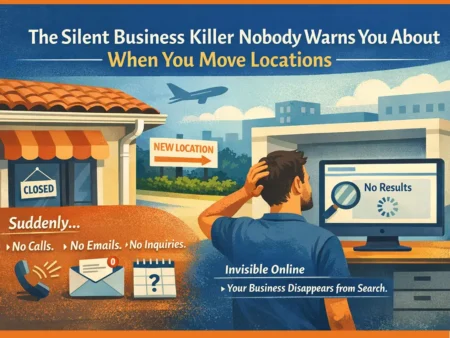
The Moment Everything Goes Quiet
Imagine waking up the morning after updating your business location online and your inbox is empty. No calls. No booking requests. No new inquiries. The reason for the absence isn’t a slowdown in business but rather a lack of visibility.
This situation is a quiet crisis that hits hundreds of small business owners every single month. They relocate, update one thing online, and, without realizing it, inadvertently trigger a switch that renders them invisible.
The internet does not automatically follow you when you move. You have to bring it with you deliberately, methodically, and well in advance.
Why the Internet Is Slow to Trust a New Address
Search platforms invest enormous resources into fighting fake listings. Bad actors have spent years gaming the system by placing businesses at addresses they do not actually occupy. People have used empty lots, mailbox stores, and friends’ garages to boost their local search rankings.
As a result of this continuous struggle, automated systems trigger a warning whenever a registered business unexpectedly updates its address. The platform is not being difficult. It is doing exactly what it was designed to do. It questions anything that appears to be manipulation.
The businesses that move through a location change without disruption are not lucky. They anticipated this skepticism and countered it before it could cause problems by conducting thorough research on the community and engaging with local stakeholders to build trust and credibility.
Building Your Case Before You Pack a Single Box
The most powerful thing you can do is make your new address feel established before you officially claim it.
Announce it publicly and repeatedly. A single buried post carries almost no weight. Multiple independent sources make a significant impact. Published announcements, third-party directory listings, and community mentions should all point to the same new location over several weeks.
Let your own platform tell the story. Post updates, share behind-the-scenes glimpses of the new space, and engage with questions. Platforms reward active, consistent engagement with trust.
Create a digital paper trail. Each new directory entry, updated profile, and published mention of your new address contributes to the credibility you are establishing. One brick means nothing. Forty bricks mean something.
Your Website Is a Witness. Make Sure It Tells the Truth
Most business owners update their homepage and stop there. This is a mistake. Your website is constantly crawled, and conflicting information across pages can create confusion that can trigger additional scrutiny.
Conduct a thorough internal audit. Old landing pages, archived posts, contact widgets in sidebars, and address mentions embedded in images must all reflect your new reality. Even a single outdated reference hiding in a footer can undermine weeks of preparation.
Beyond content, the underlying technical signals your website sends matter as well. Structured data, which is an invisible code that communicates directly with search engines, should be updated to reflect your new location with precision. Any web professional or capable AI assistant can handle the process in minutes.
Timing Is a Strategy, Not an Afterthought
The moment you choose to make your official address update is not arbitrary. Weekdays during business hours give you the best safety net. If something unexpected happens, such as a verification request, a flagged listing, or a temporary disappearance from results, you want a responsive support team available, not a skeleton crew working a holiday shift.
Make the change and remain present. Do not close the window. Do not log out. Watch what happens in real time because the next few minutes will tell you whether things went smoothly or whether you need to move into response mode.
When the Platform Pushes Back
Even a perfectly prepared business can face a verification request or a temporary hold. This is not a catastrophe. It is simply part of the process. The businesses that recover fastest are those that treated documentation as a priority from the beginning.
Official paperwork showing your business name at the new address is your most valuable asset. Keep it accessible. Respond to requests within hours, not days. Write clearly and briefly, avoiding emotional appeals and lengthy explanations. Please present the facts, include the necessary proof, and then wait for the response.
Once documentation is submitted, platforms typically move within a couple of business days. Your job during that window is to monitor your inbox carefully and respond to any follow-up requests as soon as they arrive.
After the Dust Settles
A successful address update is not the final step. It is the start of a monitoring period. For the following several weeks, check your listing regularly. Look for anything unusual, such as missing content, unexpected changes, or messages waiting for your attention.
Ranking fluctuations during this window are completely normal. Platforms are recalibrating where your business fits within its new geographic context. As long as your listing remains visible and intact, this movement is temporary and harmless.
The Businesses That Win Relocations
The businesses that succeed share one important trait. They treat the move as a multi-step communications project instead of a simple five-minute form update. They build credibility early, document everything, make the change under favorable conditions, and remain attentive afterward.
Your new location presents an opportunity to establish a fresh presence in the area while leveraging the visibility and momentum you built before your arrival. That outcome is absolutely within reach as long as you plan for the journey and not just the destination.
Frequently Asked Questions
This section covers the most common questions small business owners ask about updating a Google Business Profile address.
How long does it take for a Google Business Profile address change to go live?
In most cases, once you submit the change and complete any verification Google requests, the updated address appears within 24 to 72 hours. However, if Google requires video or postcard verification, the process can take anywhere from a few days to two weeks, depending on how quickly you complete the required steps.
Will changing my business address affect my local search rankings?
Yes, temporarily. Expect some fluctuation in local rankings for two to four weeks after the change. Google is reevaluating where your business fits in the new area. Businesses that prepare early with directory listings and other online signals usually stabilize and recover much faster.
What documents does Google typically accept as proof of a new address?
Google most commonly accepts utility bills, business insurance certificates, lease agreements, rental agreements, and official bank statements that show both your business name and the new address. The document must be recent and match the business name registered on your profile.
Can I lose my Google reviews when I change my business address?
Your reviews normally remain attached to your listing after an address change. However, if the listing is suspended during the process, reviews may temporarily or permanently disappear. This is why documenting your reviews and taking screenshots before making changes is crucial.
What is the difference between a suspended listing and a listing that needs reverification?
A reverification request means Google wants confirmation that the business is still operating at the listed address. Your listing usually remains visible during this process. A suspension means the listing has been removed from search results and requires a formal appeal with supporting documentation.
Do I need to update anything else online when I change my Google Business Profile address?
Yes. Your Google Business Profile is only one part of your online presence. You should also update your website, every page that references your address, business directories such as Yelp and Yellow Pages, social media profiles, local citations, press mentions, and the schema markup on your website. Consistency across all of these sources signals to search engines that your new address is legitimate.
Picture Source: AI-generated


