


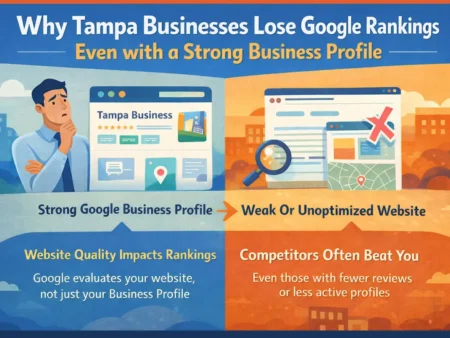
Many business owners in the Tampa Bay area believe that maintaining an active Google Business Profile is enough to rank well in local search results. Reviews are collected, photos are uploaded, and posts are published regularly. Yet despite these efforts, competitors with fewer reviews and less polished profiles sometimes appear higher in search results.
This situation is common, and the reason is often misunderstood. Google does not evaluate a Business Profile alone. The website connected to that profile plays a major role in determining search visibility. In fact, several website factors strongly influence whether a business appears in the Map Pack, the organic results below it, and the growing number of AI-generated search summaries.
Understanding how these elements work together can help Tampa business owners improve their visibility and capture more customers searching online.
Where Customers Actually Discover Local Businesses
When most people think about Google search, they picture the Map Pack at the top of the results page. This section typically shows three businesses with a map and basic details such as reviews, hours, and location.
However, a single search result page offers far more opportunities for visibility.
Below the Map Pack are organic search results, which usually include seven to ten additional listings. These are standard website results that often attract a significant number of clicks.
Another rapidly growing element is the appearance of AI-generated summaries. Tools such as Google AI Overviews, ChatGPT, and Perplexity frequently recommend businesses in their responses. These tools rely heavily on information gathered from websites rather than from Business Profiles alone.
A simple test illustrates this shift. When someone searches for “best emergency plumber in Tampa” in an AI search tool, the businesses mentioned are often selected based on the strength of their website content rather than their review count.
This broader system reflects what Google calls prominence, which measures how credible and established a business appears online. A well-optimized website plays a central role in building that credibility.
The Seven Website Factors That Influence Local Rankings
Many Tampa businesses invest heavily in their Google Business Profile but overlook several website elements that Google uses to evaluate relevance and authority. These factors work together to strengthen search visibility and provide Google with clear signals about the services a business offers and the areas it serves.
Internal Links
Internal links connect one page of a website to another. While they may appear simple, they help Google understand a website’s structure and identify the pages that carry the most value.
A strong structure often begins with the homepage linking to each major service page. Those service pages can then connect to relevant blog posts. Blog posts should return the link to the related service page. This circular structure helps search engines navigate the site and recognize the importance of specific pages.
Anchor text also matters. Instead of generic phrases like “click here,” descriptive phrases like “emergency plumbing services in Tampa” provide stronger SEO signals and help search engines interpret the content more accurately.
Local Blog Content
Blog content continues to play a meaningful role in local SEO, particularly when it reflects the concerns of a specific region.
A general educational post may attract readers but offers limited local ranking value. A blog post that discusses topics unique to Tampa, such as seasonal weather effects on roofing or water quality issues affecting plumbing systems, signals strong geographic relevance.
Publishing one or two blog posts each month is often sufficient. Each post should include natural references to the city or surrounding communities and conclude with a link to the related service page on the website.
NAP Consistency
NAP stands for Name, Address, and Phone number. Google frequently compares the information on a website with the details listed in the Google Business Profile.
Even small variations can create uncertainty. Differences such as “Suite 200” versus “Ste 200,” or inconsistent phone number formatting, can cause Google to question whether the listings refer to the same business.
Resolving this issue is straightforward. By opening the website and the Business Profile side by side, business owners can confirm that every character of the name, address, and phone number matches exactly.
Schema Markup
Schema markup is structured code placed on a website that communicates business information directly to search engines. Without schema, Google must interpret page content and determine the meaning of various details. With schema in place, that information is presented clearly and instantly.
Several types of schema are particularly helpful for local businesses. The local business schema identifies core details, such as the business name, address, and operating hours. Service schema can be used on individual service pages. Review schema highlights testimonials. The organization schema provides company information, and breadcrumb schema clarifies navigation.
Tools such as the RankMath WordPress plugin can assist with implementation, and Google provides a Rich Results Test tool that allows website owners to confirm whether schema is present.
Location Pages
Many service businesses operate across several cities but mention only one primary location on their website. While additional service areas may be listed in the Business Profile, Google still looks for supporting information on the website itself.
Dedicated location pages address this issue. Each city served should have its own page that describes the services offered in that area.
A well-constructed location page typically includes an introduction that references the city, a list of services available there, local landmarks or neighborhoods, a map, contact details, and frequently asked questions relevant to the area.
Businesses that lack these pages may miss a large share of search traffic from nearby cities.
Dedicated Service Pages
Grouping multiple services on a single page is another common issue. When this happens, Google may struggle to determine which service the business specializes in, which weakens the ranking potential of each.
Creating separate pages for each service provides clarity. A strong service page usually includes detailed descriptions, photographs, customer reviews related to that service, frequently asked questions, and clear calls to action.
Service pages typically range from 800 to 1,500 words and should reference the local area naturally.
The Homepage H1 Tag
The most influential website element is often the simplest to adjust. The H1 tag serves as the main headline on a webpage and is usually the first element Google reads when indexing a site.
Many websites use vague headlines that highlight branding but provide little information about the service or location. A more effective approach clearly communicates both.
A common formula is
Primary Service plus City plus a reason to choose the business.
Examples include headlines such as “Emergency Plumber in Tampa Available 24 Hours” or “Family Dentist in Tampa Accepting New Patients.”
Keeping the headline concise, placing the service first, and assigning a unique H1 to every page can significantly strengthen search signals.
A Practical Action Plan for Tampa Business Owners
Improving local SEO does not require a complete website rebuild. You can implement many of the most effective changes gradually.
During the first week, business owners can update the homepage H1 headline, confirm NAP consistency between the website and the Business Profile, and add schema markup through an SEO plugin.
Over the following month, creating location pages for each city served and publishing locally focused blog posts can establish a stronger foundation for search visibility.
Long-term improvements come with consistency. Publishing blog posts regularly, expanding service pages, and strengthening internal linking will gradually build authority within local search results.
Search engines typically reflect small adjustments within a few weeks, while larger structural improvements often show results within two to three months. The most significant gains often appear after several months of steady optimization.
When the Website and Business Profile Work Together
A Google Business Profile remains a powerful tool for local visibility. Reviews, images, and customer interactions continue to influence how potential clients perceive a business.
However, relying on the profile alone limits visibility. Businesses that maintain a strong profile but have weak websites may appear in the Map Pack yet remain absent from organic listings and AI-generated results.
Conversely, a strong website without an optimized Business Profile may perform well in organic results but struggle to appear in map listings.
Optimizing both together yields the strongest outcomes. Businesses that hold a position in the Map Pack and rank highly in organic search often receive the majority of clicks on a search results page.
Frequently Asked Questions About Local SEO
How quickly can search rankings improve after making changes?
Small adjustments, such as updating the homepage’s headline, may influence rankings within one to two weeks. Larger structural improvements often take several months to fully develop.
Can a business rank in Google Maps without a website?
It is possible, but much more difficult. A website strengthens credibility signals that support both map rankings and organic visibility.
Do businesses really need a location page for every city they serve?
Yes. Dedicated location pages provide Google with clear signals about where services are offered and help capture search traffic from surrounding areas.
What exactly is schema markup?
Schema markup is structured code that communicates key business details directly to search engines. It helps Google understand information such as services, location, hours, and reviews more quickly.
If a business owner has only one hour available, what should they change first?
Updating the homepage H1 headline to clearly state the primary service and city is often the fastest improvement with measurable impact.
Can website optimization overcome a competitor with more reviews?
Yes. Reviews are one ranking factor among many. A well-structured website often provides a stronger overall signal of authority and relevance.
Final Thoughts
Local search competition in the Tampa Bay area continues to grow as more businesses invest in digital marketing. While Google Business Profiles remain an essential tool, they represent only part of the ranking equation.
The structure and content of a website influence how search engines evaluate credibility, relevance, and geographic service areas. Businesses that address these factors systematically place themselves in a stronger position to appear in maps, organic results, and AI-generated search responses. For businesses seeking stronger visibility in Tampa, professional guidance can make the process significantly easier. The team at Local SEO Tampa specializes in helping local companies build the type of search presence that attracts consistent traffic and qualified leads.
Picture Source: AI-generated