


I still remember the first Tampa roofer I ever helped. He had a beautiful truck, a great crew, and a website that looked sharp. But when folks in South Tampa searched for a roofer, his business was nowhere near the top of the map. He was losing jobs to guys with worse work but better online setups. That day taught me something I tell every client now: a pretty website is not enough anymore. If you want the phone to ring, you have to understand the Google local SEO ranking factors that decide who shows up first in that little map box and who gets buried way down on page two. Google says that about two-thirds of smartphone users buy from companies that give them location-based info, so this stuff really matters. Let me walk you through what actually moves the needle for a Tampa Bay business like yours.
How Google Ranks Local Businesses (Relevance, Distance, Prominence)
Google uses three big buckets to decide the order of businesses in the local pack and on Google Maps. These are relevance, distance, and prominence. Every single Google local SEO ranking factor fits into one of these three ideas. Think of it like a three-legged stool; if one leg is short, the whole thing wobbles. When you get all three working together, your business starts climbing up the map results and stays there. Let’s walk through each one so you can spot where your business might be leaking points and losing customers to the shop down the street.
Relevance — Optimizing Your Google Business Profile
Relevance is all about how well your Google Business Profile matches what someone is searching for. And yes, it’s called Google Business Profile now, not Google My Business or GMB like the old days. If a person in Ybor City types “personal injury lawyer near me,” Google wants to hand them a lawyer who clearly does injury cases, not a general office that dabbles in everything. So the clearer and more complete your profile is, the better your chances of matching those searches and getting picked. I’ve seen businesses double their calls just by filling out every field Google gives them.
Choosing the Right Primary and Secondary Categories
Your primary category is one of the strongest signals you can send Google. Don’t just pick “attorney” if you focus on car crashes — pick “Personal Injury Attorney.” Then add secondary categories that cover the other things you do. A roofer in South Tampa might use “Roofing Contractor” as primary and add “Gutter Cleaning Service” or “Roof Repair” as extras. Being specific tells Google exactly who to show your listing to. I always tell clients to study what their top competitors picked, then be even more precise. The wrong category is like putting your store sign on the wrong street.
Writing a Keyword-Rich Business Description (750-Character Cap)
Now here’s a correction to some old advice floating around the web. Your Google Business Profile description is capped at 750 characters, not 1,000 words. So you can’t stuff a novel in there. Use every character wisely. Talk about what you do, the Tampa neighborhoods you serve like Ybor City, Hyde Park, or Brandon, and slip in your main keyword phrases in a way that reads natural. Write it like you’re talking to a real customer standing in front of you, not a robot. When I write these for clients, I read it out loud. If it sounds stiff or spammy, I rewrite it till it sounds human.
Keeping Your NAP Consistent Across the Web
NAP stands for name, address, and phone number. This has to be exactly the same everywhere your business shows up online — your website, Yelp, Facebook, directories, all of it. If your address says “Street” on one site and “St.” on another, Google gets confused and trust drops. Consistent NAP information is one of those quiet Google local SEO ranking factors that many Tampa businesses mess up on without even realizing it. I once found a Brandon plumber listed under three slightly different phone numbers across old directories. We cleaned it up, and within a couple of months his map ranking jumped. Fix it, and you’ll often see a nice bump.
Distance — Winning Location-Based Searches
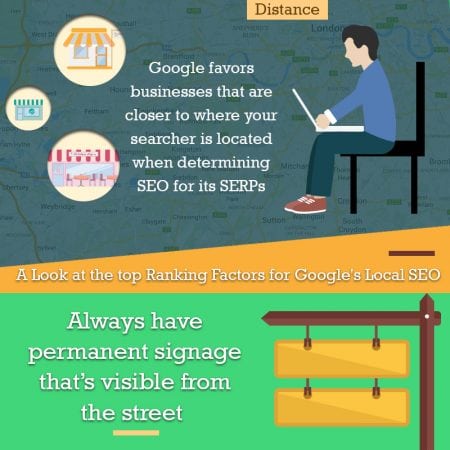
Google loves showing businesses that are close to where the searcher is standing. This is one of the most powerful ranking factors, and honestly, you can’t move your office closer to everyone in Tampa Bay. But you can do a lot to tell Google which areas you serve and make yourself more relevant across a broader part of the metro. The goal is to help Google understand that you’re a real option for someone in Riverview, even if your office is in South Tampa.
Building Effective Location Landing Pages
Location pages on your website help Google connect your business to the places you want to rank in. If you serve St. Petersburg, Clearwater, and Riverview, build a real page for each one with unique, helpful content. Don’t just copy the same page and swap city names — Google can tell, and it doesn’t help. Talk about the specific neighborhoods, mention local landmarks, and answer the questions folks in that area actually ask. Link these pages to your online profiles, including your Google Business Profile, so everything ties together nicely.
Targeting Local Keyword Phrases with Intent
Pick keyword phrases that mix your service with a place. Think “type of business + city” — like “personal injury lawyer Tampa” or “emergency plumber Brandon.” Then use that same phrase in a few key spots:
- Put it in your page permalink, like example.com/tampa/personal-injury-lawyer/
- Use it in your page title, main heading, and body copy
- Add it to your meta description and image file names
- Include your name, address, and phone number on the page when you can
Tampa Bay is a crowded market. Roofers, injury attorneys, and emergency plumbers are all fighting for the same clicks, so targeting the right intent-driven phrases really matters if you want to stand out in the local pack. Somebody typing “emergency plumber Riverview” at midnight is ready to call right now. That’s the searcher you want to catch.
Prominence — Standing Out From Local Competitors
Prominence is where you can really pull ahead of the other guys. It’s Google’s way of measuring how well-known and trusted your business is, both online and in the real world. This is a big part of any smart local SEO plan, and it’s often the piece that separates the top three from everybody else. Two roofers can have identical profiles, but the one with more trust signals wins the top spot.
Reviews and Reputation Signals
Reviews are huge. More good reviews on your Google Business Profile usually mean higher rankings and more folks clicking your listing. Get reviews on other trusted sites too, like Facebook and Yelp. And here’s the truth about asking — Google actually allows you to ask your happy customers for reviews. What Google does not allow is paying for reviews, offering discounts in exchange for them, or posting fake ones. So ask away, just keep it honest. My favorite trick? Ask right after you finish a great job, when the customer is still smiling. That’s when they’ll say yes.
Citations, Backlinks, and Web Presence
Citations are mentions of your business name on other websites, and backlinks are links pointing back to your site. The more quality citations and links you have, the more Google sees you as a real, established Tampa business. Get listed in local directories, chamber of commerce pages, and industry sites. Sponsor a Little League team in Brandon or a community event in Hyde Park, and you’ll often earn a link and some goodwill. Every solid mention builds your web presence and boosts your local rankings.
Photos and Physical Signage
Add as many good photos to your profile as you can — at least more than your competitors have. Show your team, your storefront, your work, before and after shots. Google also tries to mirror how prominent a business looks in the offline world, so having permanent signage that’s easy to see from the street actually helps. It sounds funny, but your real-life presence feeds into your online ranking. A visible sign on Kennedy Boulevard signals to Google and others that you’re a legit, rooted business.
Ranking Factors for Multi-Location Businesses
If you’re running a multi-location business or a Florida franchise, there are a few extra rules to follow. Google is strict about this stuff to stop fake listings from flooding the map.
- Staff each location during your posted business hours — don’t just rent an empty office to grab another address.
- Hire real staff. Virtual offices and co-working spaces cause filtering problems, so your listing might get hidden.
- Always have permanent signage visible from the street at every spot.
- Give each location its own Google Business Profile and its own page on your website.
Handling multi-location local SEO the right way keeps all your locations ranking instead of competing with each other. I’ve watched franchises accidentally cannibalize their own listings because the pages were carbon copies. Give each spot its own identity and its own real details, and they all do better.
Common Local SEO Mistakes to Avoid
A lot of small businesses in Tampa trip over the same problems. Watch out for these:
- Inconsistent NAP info spread all over the web
- Picking a category that’s too broad or just plain wrong
- Leaving your profile half empty with no photos or description
- Buying fake reviews (this can get you penalized hard)
- Ignoring your website and hoping the profile does all the work
Fixing these basics often does more for your ranking than any fancy trick. Most of the time when a new client comes to me frustrated, it’s not because they need something clever; it’s because one of these simple things is broken. Get the fundamentals right first, and the results follow.
Frequently Asked Questions
How long does local SEO take to work?
Most Tampa businesses start seeing movement in about three to six months. It depends on how competitive your industry is and where you’re starting from. A brand new roofer in a busy South Tampa market takes longer than a niche shop with less competition. Local SEO is a slow build, not an overnight switch, but the results tend to stick around once you’re ranking.
Do reviews affect local rankings?
Yes, they really do. The number of reviews, how good they are, and how often you get new ones all feed into your ranking. Reviews also make people trust your listing more, so you get more clicks and calls. Just remember to earn them honestly by asking your happy customers right after a job well done.
What is NAP consistency?
NAP consistency means your business name, address, and phone number are written exactly the same way across all online listings. When they match, Google trusts your info and ranks you higher. When they don’t, it can hurt your visibility in the local pack. Even small differences like “St.” versus “Street” can throw things off.
Can I rank without a physical address?
Service-area businesses can rank without showing a public address, but you still need a real, verified location that Google can confirm. You can hide the address on your profile and just list the areas you serve, like Tampa, St. Pete, and Clearwater. A fake or virtual address violates Google’s policies and can get your listing suspended.
Get Help From Local SEO Tampa
These are only a handful of the Google local SEO ranking factors that decide who wins the map pack. Each piece — relevance, distance, and prominence — plays its part, and pulling them all together takes time you probably don’t have while running your business. That’s where we come in. Local SEO Tampa helps small businesses and multi-location Florida franchises in Ybor City, Hyde Park, Brandon, Riverview, and beyond get found, rank higher, and attract more customers. Reach out to us and let our team handle the local optimization so you can focus on doing what you do best.